12 min read
Why the word luxury needs a definition
Walk through any premium furniture floor in Makati, Bonifacio Global City or Alabang and the word luxury appears on almost every label. It is attached to mattresses of every construction, every material and every level of craft. For a buyer, that makes the word nearly meaningless. A thicker mattress is not necessarily a better one, a quilted cover is not necessarily a sign of quality, and a long list of layers can simply describe a long list of foams.
A more useful definition looks beneath the cover. True luxury in a mattress is the sum of three things: how the support system is built, what the comfort layers are made from, and how much of the making is entrusted to skilled hands rather than to machines. Each of these can be inspected, discussed and felt. Together they decide how a bed sleeps on the first night and how it continues to sleep long after the novelty has faded.
This guide uses that definition throughout. It is written for homeowners furnishing a principal residence, a weekend house in Tagaytay or a family home in the provinces, as well as for the interior designers and architects who advise them. Wherever the guide refers to Vispring, it describes the way Vispring beds are made in Plymouth, England, and presented in the Philippines by Luxeroom in Metro Manila.
The three hallmarks of a true heirloom bed
The first hallmark is a pocket-spring system built with care. In a pocket-spring mattress each spring is enclosed in its own fabric pocket so that it moves independently of its neighbours. The quality of that system depends on how the springs are made, how they are arranged and how they are joined. At Vispring, springs are nested by hand into a honeycomb arrangement, a slow process that allows the system to be built around the bed rather than pressed into it.
The second hallmark is the use of natural fillings. Instead of relying on synthetic foams for comfort, a handcrafted bed is layered with natural fibres such as cotton, wool, silk, cashmere and horsetail. Each fibre is chosen for a particular contribution, whether softness, resilience or breathability, and the way they are combined gives each model its character.
The third hallmark is hand finishing. The border of a Vispring mattress is side-stitched by hand, and the surface is hand-tufted so that the fillings stay where they were placed. These steps take time and skill, and they are among the clearest visible signs that a bed has been made rather than manufactured. When you visit a showroom, look closely at the border and the tufts: they tell you much of what you need to know.
Understanding pocket springs
The spring system is the skeleton of a mattress. In an open-coil design the springs are linked to one another, so pressure on one area travels across the surface. In a pocket-spring design, each spring works on its own. When you lie down, the springs beneath your shoulders, hips and legs respond separately to the weight above them, which allows the support to follow the contours of the body.
Pocket springs also change how a bed behaves for two. Because each spring moves independently, the movement of one sleeper is less likely to travel across the mattress to the other. For couples with different schedules, or for anyone who wakes easily, this independence is often the single most noticeable difference between a pocket-spring bed and a conventional one.
Not every pocket-spring mattress is equal. The fabric of the pockets, the way the springs are nested and whether they are placed by hand or by machine all affect the result. Vispring's more elaborate models add further layers of springs, building support in tiers. Rather than reading specifications, the most reliable way to understand these differences is to lie on several constructions in turn and notice how each one responds.
Natural fillings and why they matter
Above the springs sit the comfort layers, and this is where the choice of material becomes personal. Many modern mattresses rely on memory foam, latex blends or polyurethane for softness. A handcrafted Vispring bed uses natural fibres instead, laid by hand in layers so that each one can do its particular work.
Cotton offers a soft, smooth comfort layer. Wool is prized for its loft and its natural springiness. Silk brings a fine, airy softness. Cashmere is among the most delicate fibres used in bedding, while horsetail, teased and curled, gives a resilient layer that holds its shape. The proportion and order of these fibres differ between models, which is why two Vispring beds can feel quite distinct while sharing the same philosophy.
Natural fibres are valued for letting air move through the mattress and for managing moisture. In a country where the nights are often warm and the air is often humid, that quality is not a luxury detail but a practical consideration. Our separate guides on cooling mattresses and on natural fillings versus memory foam explore these properties in greater depth.
The tropical reality: buying for the Philippine climate
Most mattress advice is written for temperate countries, where bedrooms are cool for much of the year. The Philippines asks different questions of a bed. Even in an air-conditioned master suite, the body releases heat and moisture through the night, and a mattress that cannot let that heat and moisture escape can make sleep feel close and restless.
This is where construction becomes decisive. An open spring core allows air to circulate beneath the sleeper, and natural fibres allow moisture to move rather than collect at the surface. Dense synthetic layers, by contrast, can hold warmth against the body. When comparing mattresses in Manila, it is worth asking not only how a bed feels in a cool showroom but how it is likely to feel at three in the morning in the rainy season.
Climate also affects how a mattress should be looked after. Regular airing, a breathable protector and turning or rotating as advised all help a natural mattress stay fresh in humid conditions. Our journal piece on caring for a luxury mattress in a humid climate offers practical guidance for Filipino homes.
Tension, not just firmness
Shoppers often describe the bed they want as soft, medium or firm. Those words are a useful start, but they hide an important distinction. Firmness describes how a surface feels to the hand. Tension describes how the spring system responds to the weight and shape of a particular body. Two people lying on the same mattress may experience it quite differently.
A heavier sleeper may find that a bed which feels firm to the hand yields comfortably once they lie down, while a lighter sleeper may find the same bed unyielding. The aim is not to choose the firmest or the softest bed, but the one whose support keeps the body comfortably aligned while allowing the shoulders and hips to settle naturally.
Vispring beds can be made in different tensions, and for couples with different needs it is possible to discuss options that allow each side of the bed to suit its sleeper. Our guide to choosing mattress firmness and tension explains how to approach this decision in a showroom.
The complete bed: divans, headboards and toppers
A mattress does not work alone. The base beneath it shapes how the whole bed behaves. A sprung divan works with the mattress above it, adding a further layer of give and support, while a rigid platform asks the mattress to do all of the work. For a handcrafted mattress, a matching Vispring divan is designed to complete the sleep system rather than simply hold it up.
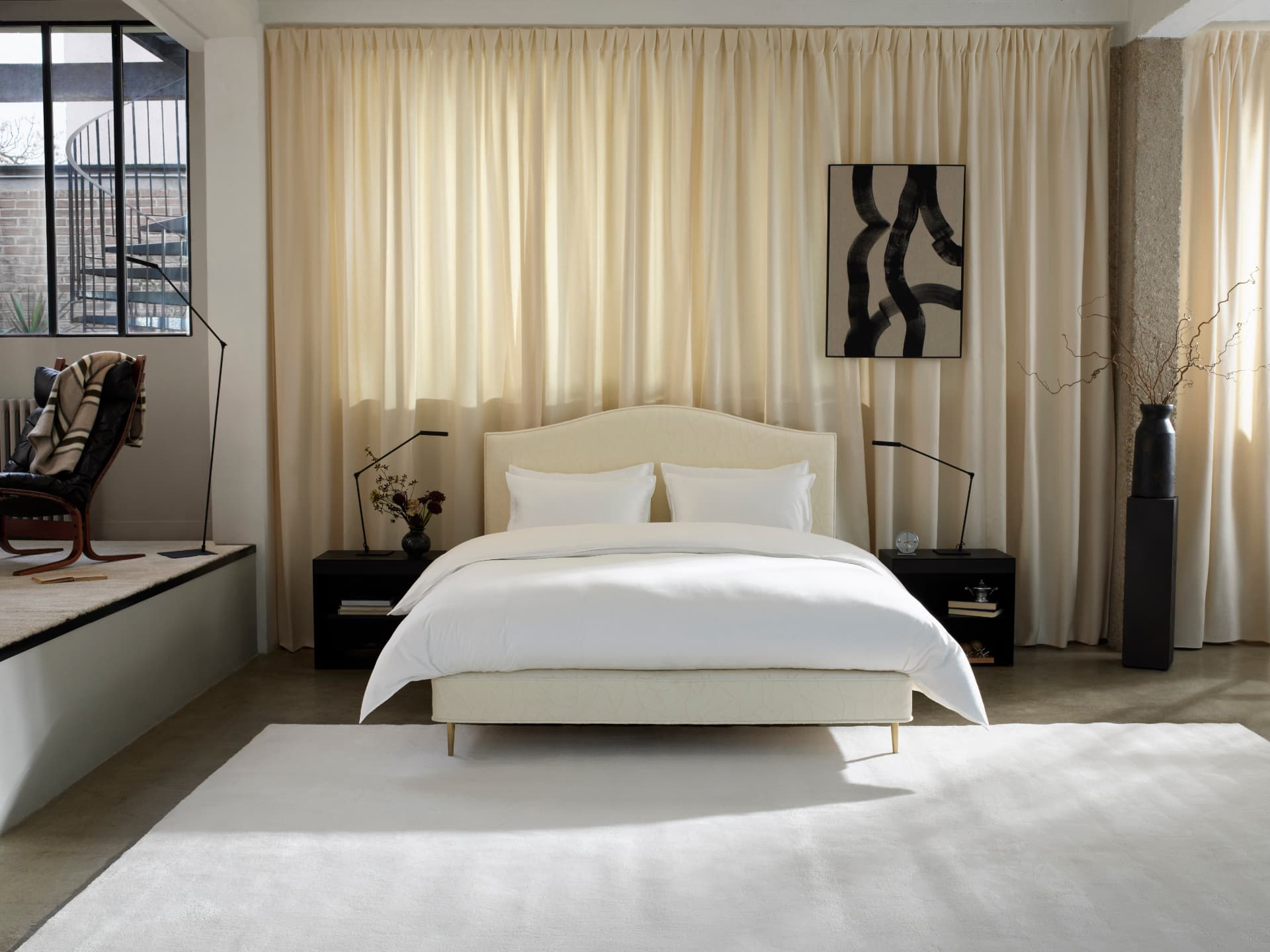
The headboard, meanwhile, is the bed's face in the room. It sets the tone of a master suite, frames the view as you enter and provides a comfortable surface for reading. Vispring headboards are offered in a range of shapes and can be upholstered in fabrics chosen to suit the interior.
A topper adds a final, removable layer of comfort. It can soften the feel of a bed, protect the mattress beneath and be aired or replaced independently. Our guides to divans and headboards and to luxury mattress toppers cover each element in detail.
Navigating the Vispring collections
Vispring presents its mattresses in three collections. The Original Collection is a considered introduction to Vispring comfort, combining resilient pocket springs with natural fillings. The Classic Collection offers refined support and layered natural materials for a more nuanced sleep experience. The Luxe Collection represents the pinnacle of Vispring craftsmanship, with multiple spring layers and the most precious natural materials.
Moving from one collection to the next is not simply a matter of adding softness. Each step introduces a more elaborate construction and a richer palette of fibres, which changes the character of the bed as much as its comfort. Some sleepers prefer the clarity of a simpler construction; others are drawn to the depth of the Luxe models.
Our guide comparing the Original, Classic and Luxe collections sets out how to think about each one, and the collection pages on this site describe the individual models.
A buyer's checklist for the showroom
Before you visit any showroom, it helps to arrive with a short list of questions. Ask how the springs are made and whether they are placed by hand. Ask what each comfort layer contains, in order, from the springs to the surface. Ask whether the border is side-stitched by hand and whether the surface is hand-tufted. Ask how the mattress should be turned, rotated and aired, and what base it is designed to sit on. The answers will tell you more about a bed than any label or brochure.
Then use your senses. Look closely at the border and the tufts. Sit on the edge. Lie down in your usual position and stay there for several minutes, then turn over and notice how easily you move. If you share your bed, ask your partner to lie beside you and change position while you keep still. Finally, compare at least two or three constructions so that you have a point of reference. A considered choice is almost always a comparative one, and the bed you remember most clearly after leaving is usually the one worth returning to.
Vispring in the Philippines
Vispring has made beds by hand in Plymouth, England, since 1901, and its approach has remained remarkably consistent: pocket springs nested by hand, natural fibres laid by hand, borders side-stitched and surfaces hand-tufted, with every bed made to order. Those principles were not developed with the tropics in mind, yet they translate unusually well to the conditions of a Filipino home, where breathability, moisture management and quiet, independent support all matter night after night.
In the Philippines, Vispring is presented by Luxeroom, the official Vispring partner in Metro Manila. Rather than a conventional retail floor, Luxeroom offers private consultations by appointment, giving homeowners, couples, interior designers and architects unhurried time with the Original, Classic and Luxe collections, along with divans, headboards and toppers. A consultation is the place to translate everything in this guide into a specific choice for a specific room and a specific sleeper.
Whether you are furnishing a condominium in Makati or BGC, a family home in Alabang or Forbes Park, a retreat in Tagaytay or a villa by the sea, the same advice applies: understand how a bed is made, try it for long enough to feel what it does, and choose the one that suits the way you actually sleep. Luxeroom can also arrange a follow-up conversation over WhatsApp if you would like to continue planning after your visit.
Preparing for your consultation
A private consultation is most useful when you arrive prepared. Before your appointment, spend a few nights paying attention to how you sleep now. Notice the position you fall asleep in and the one you wake in, whether you feel warm during the night, and whether anything about your current bed bothers you. If you share your bed, ask your partner to do the same, and agree to attend together so that the bed is chosen for both of you rather than for one.
Bring practical information as well. Measurements of the bedroom, photographs of the space, details of any bed frame you plan to keep and notes on the delivery route into your home all help the conversation move from the general to the specific. If an interior designer or architect is involved, invite them, or bring their drawings. Wear comfortable clothes, allow at least an hour, and bring your usual pillow if you can. These simple preparations mean you leave with a clear sense of which beds suit you, rather than a vague impression of many.
Above all, give yourself permission to take your time. A luxury mattress is chosen for years of nightly use, and there is no virtue in deciding quickly. Lie on each bed for several minutes, return to the ones you liked, and ask every question that occurs to you. A good specialist will welcome the care you bring to the decision, because it is the same care that went into making the bed.
How to choose: the private consultation
No guide can replace the experience of lying on a bed. The most reliable way to choose a luxury mattress is to try several, unhurried, in your usual sleeping position, with someone who can explain what you are feeling. Allow time for each bed; the first impression in the first minute is rarely the most useful one.
In the Philippines, Vispring is presented by Luxeroom, the official Vispring partner in Metro Manila, through private consultations by appointment. A consultation is a conversation about how you sleep, the room the bed will live in and the look you want to achieve, followed by time to experience the collections in person.
If you are working with an interior designer or architect, bring them along or share their drawings. A bed is a long-term commitment, and it deserves the same care as any other piece of fine furniture in the home.
Questions, answered
- What makes a mattress a true luxury mattress?
- Look for a well-made pocket-spring system, natural fillings rather than synthetic foams, and hand finishing such as side-stitched borders and hand tufting. Together these decide how a bed sleeps and how it endures.
- Where can I try a Vispring mattress in the Philippines?
- Vispring is presented in the Philippines by Luxeroom, the official Vispring partner in Metro Manila, through private consultations by appointment.
- Is a natural-fill mattress suitable for the Philippine climate?
- Natural fibres are valued for letting air move and for managing moisture, which matters in a warm, humid climate. Regular airing and a breathable protector help keep the bed fresh.
- Should I choose a firm or a soft mattress?
- Think in terms of tension rather than firmness. The right bed keeps your body comfortably aligned for your weight and sleeping position, which is best judged in person.
- Do I need a matching divan?
- A sprung divan is designed to work with the mattress above it as one sleep system. A consultation can help you decide whether a divan suits your bed frame and room.