10 min read
A short history of the sprung mattress
Before springs, mattresses were stuffed with whatever was available: straw, wool, feathers, horsehair. Comfort depended entirely on the filling and on how often it was beaten and turned.
The arrival of springs transformed beds, adding resilience that fillings alone could not achieve. Early designs linked springs together into a single unit, which gave support but carried movement from one side of the bed to the other.
Vispring was founded in 1901 around a different idea: springs sewn into individual fabric pockets so that each could move independently. That principle, refined by generations of makers in Plymouth, remains at the heart of every Vispring bed.
Open coil versus pocket springs
In an open-coil mattress, springs are joined by wires into one connected frame. Press on one area and the surrounding springs move with it. These mattresses can be economical and durable, but the support is shared rather than individual.
In a pocket-spring mattress, each spring sits in its own fabric pocket. The pockets are joined, but the springs inside move on their own. Pressure on one area is met by the springs directly beneath it.
The practical result is support that follows the shape of the body more closely, and a bed in which one sleeper's movement is less likely to disturb the other.
What hand nesting means
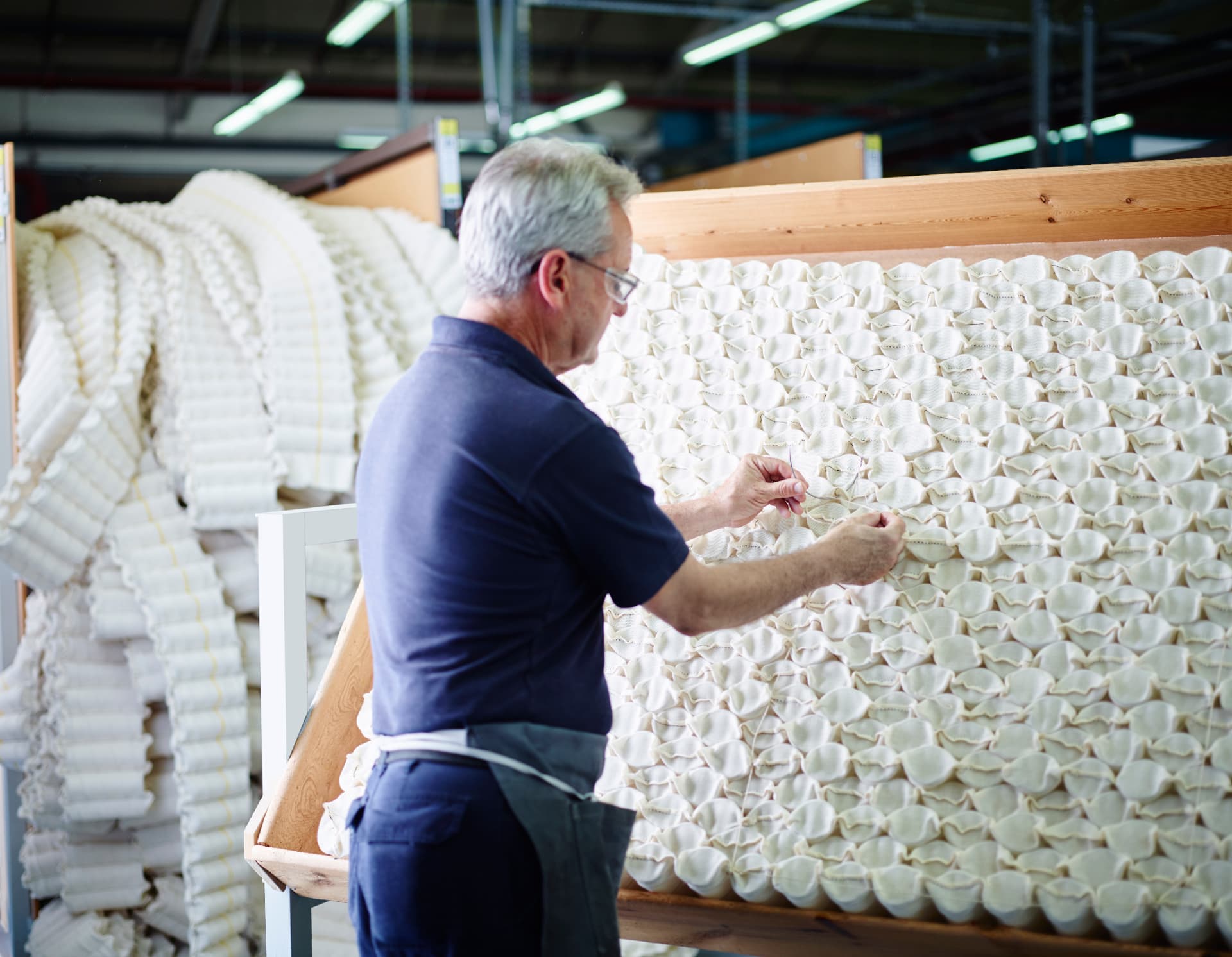
Once springs are pocketed, they must be arranged. Many manufacturers line up pocketed springs in rows by machine. Vispring nests its springs by hand into a honeycomb arrangement, fitting each one closely among its neighbours.
Nesting by hand allows the maker to build the spring system around the dimensions of each bed, rather than cutting a standard unit to size. It is slow work, and it is one reason every Vispring bed is made to order.
You can see the process on our craftsmanship pages, where makers place each pocketed spring by hand.
Layers and tiers of springs
Some mattresses use a single layer of springs; others build support in tiers. A layered spring system can change the way a bed responds, adding depth to the support.
Within the Vispring collections, the more elaborate models introduce additional spring layers. The Luxe Collection, the pinnacle of Vispring craftsmanship, features multiple spring layers alongside the most precious natural materials.
More springs or more layers do not automatically mean a better bed for you. The question is how the construction feels for your body, which is why trying each collection in person is so valuable.
Support that follows the body
The body is not flat. Shoulders and hips are heavier and wider; the waist and lower back sit in between. A good mattress lets the heavier areas settle while continuing to support the areas between them.
Independent pocket springs respond to this varying load. Where weight is greater, springs compress further; where it is lighter, they push back gently. The aim is comfortable, natural alignment in your usual sleeping position.
Tension, the responsiveness of the springs, can be chosen to suit different builds. Our firmness and tension guide explains how to approach that choice.
Motion, sound and sleeping well together
When partners share a bed, movement matters. Each time one turns, gets up or lies down, a connected spring unit can carry that motion across the mattress.
Pocket springs reduce that transfer because the springs beneath one sleeper are not tied to those beneath the other. The surface remains buoyant and easy to move on, without the sinking feel of dense foam.
Couples with different schedules often find this the single most valuable quality of a pocket-spring bed.
A breathing core for the tropics
A pocket-spring core contains space as well as springs. That space allows air to move through the mattress, a quality of particular value in the warm, humid climate of the Philippines.
As you change position, the springs compress and recover, helping air circulate within the mattress. Combined with natural fillings that allow moisture to move, the construction helps the bed feel more temperate.
Our cooling mattress guide explores breathability in detail.
The springs and the divan beneath
Vispring divans are themselves sprung, with hand-nested pocket springs beneath natural fillings on a timber frame. The mattress and divan work together as a single sleep system.
A sprung divan adds a further layer of give, so the support is shared between the two rather than resting entirely on the mattress. Placed on a rigid platform instead, the same mattress can feel different.
Our guide to divans and headboards explains how to choose a base for a pocket-spring mattress.
The pocket: fabric matters too
Attention naturally falls on the springs themselves, but the pocket that holds each spring matters as well. The pocket keeps the spring in place, allows it to move independently and connects it to its neighbours.
Traditionally, pocket springs were enclosed in natural fabric such as calico. A breathable pocket fabric supports the airflow that makes a spring core valuable in a humid climate. When comparing mattresses, it is worth asking what the pockets are made of.
Small details like this are easy to overlook, yet they reflect the care with which a spring system has been built.
Common myths about springs
One common belief is that springs are noisy or will eventually poke through. In older open-coil designs, worn springs could indeed creak. In a well-made pocket-spring mattress, each spring is enclosed in fabric and surrounded by fillings, so it moves quietly.
Another belief is that the number of springs alone determines quality. Spring count is only one variable among many: how the springs are made, how they are arranged, how they are pocketed and what surrounds them all matter at least as much.
A third belief is that springs are old-fashioned compared with foam. In fact, the independent pocket spring remains one of the most effective ways to create responsive, breathable support, which is why it continues to sit at the heart of many of the world's finest beds.
Springs and natural fillings together
Springs and fillings are partners. The springs provide support and responsiveness; the fillings above them provide comfort, cushioning and moisture management. Neither works as well alone.
In a Vispring bed, natural fibres such as wool, cotton, silk, cashmere and horsetail are laid by hand above the springs and held in place by hand tufting. The fillings smooth the surface while allowing the springs beneath to respond to the body.
The balance between spring tension and filling depth shapes the overall feel of each model. That is why two mattresses with similar springs can feel quite different.
Caring for a pocket-spring mattress
A pocket-spring mattress rewards simple, regular care. Turning or rotating it as advised for your model helps the springs and fillings wear evenly, so that no single area carries all the load.
Airing the mattress when you change the linen allows moisture to escape, which is especially helpful in the Philippine climate. A breathable protector shields the mattress from everyday spills while preserving airflow.
Avoid standing or jumping on the mattress, and sit in different places on the edge rather than always in the same spot. These small habits help a well-made bed stay comfortable for many years.
The edge of the spring system
The edge of a mattress is where many sleepers sit to dress, read or put on shoes, and where couples often sleep closest. In a pocket-spring mattress, the springs at the perimeter must be supported so that the edge holds its shape and the full width of the bed remains usable. Some manufacturers wrap the spring unit in a foam border to achieve this.
Vispring takes a different approach. The border is side-stitched by hand, with makers drawing twine through the edge to bind the outer springs and fillings together. This traditional technique gives the mattress a firm, defined edge without relying on foam. When you visit a showroom, sit on the edge of several mattresses and compare how each one responds. The difference between a hand-stitched edge and a foam-wrapped one is often easy to feel.
Pocket springs and the Philippine home
For households in the Philippines, pocket springs bring together several qualities that matter especially in a tropical setting. Their open structure allows air to move through the mattress. Their independent movement helps couples sleep undisturbed. Their responsiveness makes turning easy, which helps on warm nights when the body changes position more often.
Combined with natural fillings that manage moisture, a hand-nested pocket-spring mattress is designed for comfort in the conditions that Filipino homes actually experience. It is not a technology adapted for the tropics as an afterthought, but a construction whose fundamental qualities happen to suit a warm, humid climate remarkably well.
Vispring in the Philippines
Vispring has made beds by hand in Plymouth, England, since 1901, and its approach has remained remarkably consistent: pocket springs nested by hand, natural fibres laid by hand, borders side-stitched and surfaces hand-tufted, with every bed made to order. Those principles were not developed with the tropics in mind, yet they translate unusually well to the conditions of a Filipino home, where breathability, moisture management and quiet, independent support all matter night after night.
In the Philippines, Vispring is presented by Luxeroom, the official Vispring partner in Metro Manila. Rather than a conventional retail floor, Luxeroom offers private consultations by appointment, giving homeowners, couples, interior designers and architects unhurried time with the Original, Classic and Luxe collections, along with divans, headboards and toppers. A consultation is the place to translate everything in this guide into a specific choice for a specific room and a specific sleeper.
Whether you are furnishing a condominium in Makati or BGC, a family home in Alabang or Forbes Park, a retreat in Tagaytay or a villa by the sea, the same advice applies: understand how a bed is made, try it for long enough to feel what it does, and choose the one that suits the way you actually sleep. Luxeroom can also arrange a follow-up conversation over WhatsApp if you would like to continue planning after your visit.
Preparing for your consultation
A private consultation is most useful when you arrive prepared. Before your appointment, spend a few nights paying attention to how you sleep now. Notice the position you fall asleep in and the one you wake in, whether you feel warm during the night, and whether anything about your current bed bothers you. If you share your bed, ask your partner to do the same, and agree to attend together so that the bed is chosen for both of you rather than for one.
Bring practical information as well. Measurements of the bedroom, photographs of the space, details of any bed frame you plan to keep and notes on the delivery route into your home all help the conversation move from the general to the specific. If an interior designer or architect is involved, invite them, or bring their drawings. Wear comfortable clothes, allow at least an hour, and bring your usual pillow if you can. These simple preparations mean you leave with a clear sense of which beds suit you, rather than a vague impression of many.
Above all, give yourself permission to take your time. A luxury mattress is chosen for years of nightly use, and there is no virtue in deciding quickly. Lie on each bed for several minutes, return to the ones you liked, and ask every question that occurs to you. A good specialist will welcome the care you bring to the decision, because it is the same care that went into making the bed.
How to judge a pocket-spring mattress in person
Ask how the springs are arranged and whether they are nested by hand. Look at the border: hand side-stitching shows that the edge has been built with care. Look at the surface: hand tufting keeps the fillings in place.
Lie on the bed in your usual position for several minutes. Turn over. Ask your partner to lie down and move while you stay still. Sit on the edge.
Luxeroom, the official Vispring partner in Metro Manila, can guide you through these tests in a private consultation by appointment.
Questions, answered
- What is a pocket spring mattress?
- A mattress in which each spring is enclosed in its own fabric pocket and moves independently, so support follows the body and movement travels less across the bed.
- What does hand-nested mean?
- At Vispring, pocketed springs are placed by hand into a honeycomb arrangement, so the spring system is built around each bed rather than cut from a standard unit.
- Are more springs always better?
- Not necessarily. Layered spring systems change how a bed responds, but the right construction is the one that feels best for your body and sleeping position.
- Do pocket springs help in hot weather?
- A spring core contains space that allows air to move, which, combined with natural fillings, helps a mattress feel more temperate in a humid climate.