11 min read
Two philosophies of comfort
Modern mattresses tend to follow one of two philosophies. The first builds comfort from engineered synthetic materials, most often memory foam and polyurethane foams, sometimes combined with a spring unit. The second builds comfort from springs and natural fibres, layered and finished by hand.
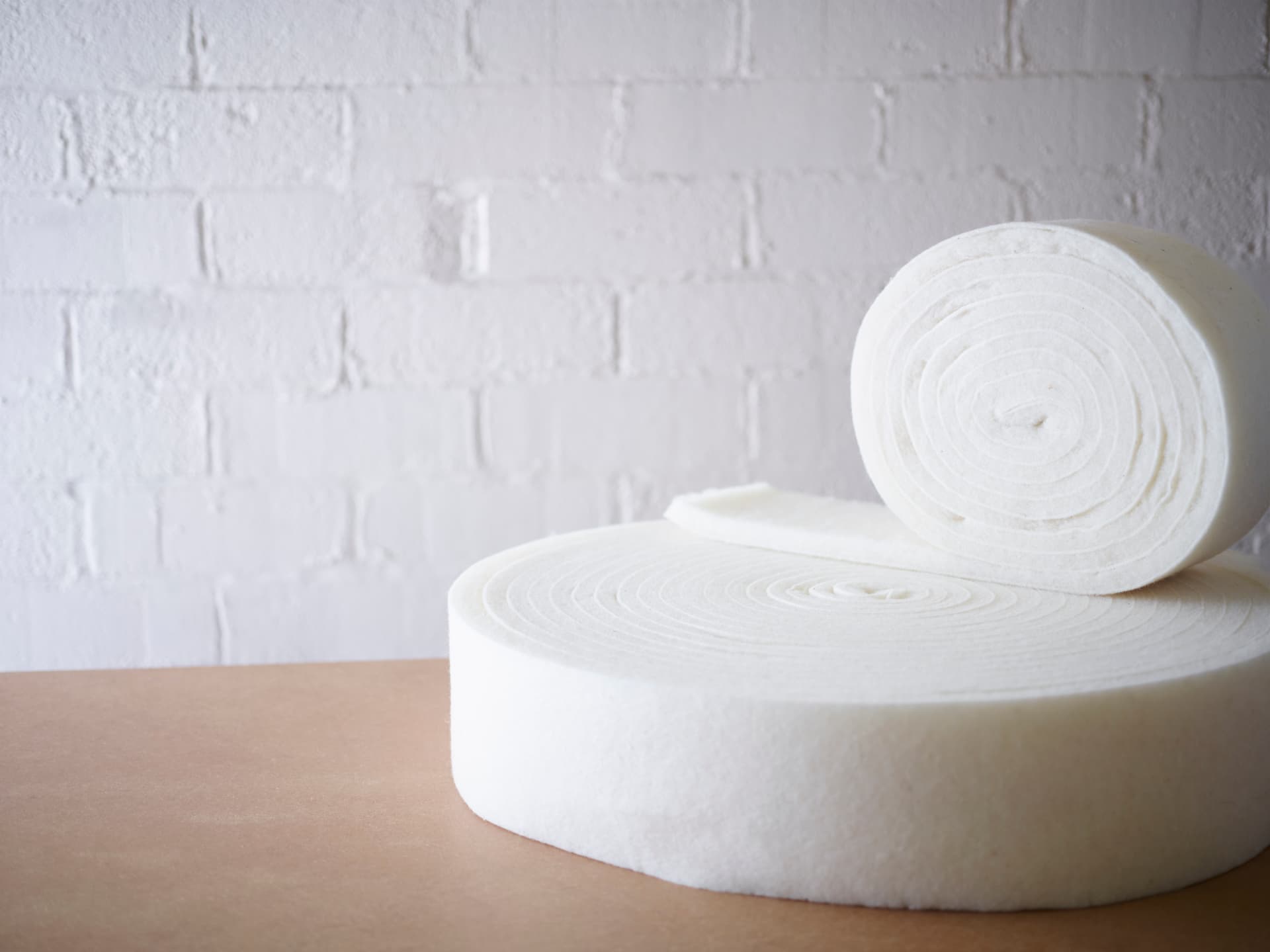
Memory foam rose to popularity because it offers a distinctive sensation: it softens with warmth and moulds slowly around the body. It can be manufactured at scale, compressed for delivery and produced to a consistent specification.
The natural approach is older and slower. It relies on the qualities of materials such as wool, cotton, silk, cashmere and horsetail, and on the skill of the people who lay and finish them. Vispring has worked this way in Plymouth since 1901.
How each one feels
Memory foam is often described as enveloping. As you lie down it yields gradually and holds an impression of your shape. Some sleepers love this sense of being cradled; others find it makes changing position feel like an effort.
A natural-fill pocket-spring mattress feels more buoyant. The springs respond to the body directly, and the natural fibres above them cushion without the slow, sinking quality of foam. Moving across the bed tends to feel easier.
Neither feel is objectively right. The point is to know which you prefer, and that is best discovered by lying on both for a meaningful length of time.
Breathability in a humid climate
In the Philippines, the most practical difference between the two approaches is often temperature. Dense foam leaves limited space for air to move, and many sleepers find it holds warmth close to the body.
A pocket-spring core contains space around the springs, allowing air to circulate. Natural fibres such as wool can take up moisture vapour and release it again, while horsetail forms an open, resilient layer. The construction breathes from the core outwards.
For hot sleepers in Metro Manila, this difference can matter more than any other. Our cooling mattress guide explores it in detail.
Air quality in the modern bedroom
Newly manufactured synthetic products, including some foams, can carry a noticeable odour when first unwrapped. Many households, particularly in compact condominium bedrooms, prefer furnishings with a simpler material story.
Natural fillings have a straightforward composition: fibres from sheep, silkworms, cotton plants and horses, prepared and laid by hand. For buyers who want to understand exactly what they sleep on, that clarity is part of the appeal.
Whatever you choose, ventilate a new bed and the bedroom well in the first days, and ask your retailer about the materials used in each layer.
Resilience and how a mattress ages
Every mattress changes with use. Foam layers can gradually soften and, depending on their quality, may begin to hold body impressions that do not recover.
Natural fillings settle too, and some settling is part of how a handcrafted mattress becomes your own. The fibres are laid and hand-tufted so that they stay in place, and turning or rotating the mattress as advised helps them settle evenly.
Fibres such as horsetail and wool are valued for their resilience, recovering after compression. How any mattress ages depends on its construction, its care and its use, so ask about the recommended routine for the model you choose.
Edges, borders and hand side-stitching
The edge of a mattress is where many constructions reveal their compromises. Some rely on a foam border to keep the shape square; others reinforce the edge with a wire frame.
A Vispring mattress is side-stitched by hand. Skilled makers draw twine through the border to bind the edge of the spring system and fillings together, giving the mattress its shape and supporting the edge without a foam encasement.
When you visit a showroom, sit on the edge of each bed you consider and look closely at the border. Rows of hand stitching are one of the clearest signs of a made, not manufactured, mattress.
Motion and sleeping as a couple
Memory foam is often promoted for absorbing movement, and its dense structure does damp motion. The trade-off is the sinking sensation some sleepers dislike, and the warmth already discussed.
Pocket springs approach the problem differently. Because each spring moves independently, the movement of one sleeper is less likely to travel across the bed, while the surface stays buoyant and easy to move on.
For couples, it is also worth considering tension. Partners of different builds may prefer different support, and a consultation can explore options for each side of the bed.
Craftsmanship and sustainability
Mass-produced foam mattresses are designed for efficiency of manufacture and delivery. A handcrafted mattress is designed around the qualities of its materials and the skills of its makers.
Natural fibres are renewable materials, and a well-made mattress that is cared for is intended to be kept rather than quickly replaced. For many households, buying fewer, better things is itself a form of sustainability.
Vispring's approach is visible at every stage, from hand-nested springs and hand-laid fillings to side-stitched borders and hand tufting. You can see the process on our craftsmanship page.
Hybrid mattresses: the middle ground
Between pure foam and fully natural construction sits a large category of hybrid mattresses. These usually combine a pocket-spring core with comfort layers of foam, sometimes topped with a thin layer of natural fibre. They aim to offer the responsiveness of springs with the familiar feel of foam.
A hybrid can be a reasonable compromise, but it is worth understanding what the word means in each case. A mattress described as wool-topped may still rely largely on synthetic foam for its comfort. When comparing, ask what proportion of the comfort layers is natural and what is synthetic, and how the layers are held in place.
A Vispring mattress is not a hybrid in this sense. Its comfort comes from natural fibres laid by hand above hand-nested springs, held in place by hand tufting. Understanding that distinction helps you compare like with like rather than being guided by a label.
Feel over time: the first night and the thousandth
A mattress showroom shows you the first night. Foam often makes a strong first impression, because its slow, enveloping response is immediately distinctive. Natural-fill mattresses can feel quieter at first: buoyant, supportive, and less dramatic in the first minute.
What matters, though, is the thousandth night. Over months and years, the way a mattress manages warmth, how its comfort layers respond to daily use and how easily you can move on it become far more important than the first impression. This is where a well-made natural mattress tends to earn its place.
When you try beds, resist the temptation to judge in a moment. Lie down for longer, change position several times, and ask yourself which bed you would want to sleep on through a warm night in the rainy season.
Allergies, dust and natural fibres
Buyers sometimes ask whether natural fibres are suitable for people who are sensitive to dust or allergens. The honest answer is that every bed, natural or synthetic, benefits from good hygiene: a breathable protector, regular laundering of linen, airing of the mattress and a well-ventilated bedroom.
Natural fibres used in a well-made mattress are prepared and cleaned before they are laid. Moisture management also matters, since a bed that stays drier is generally easier to keep fresh. If you have a specific sensitivity, discuss it with a health professional and ask the retailer about the materials in each layer.
This guide makes no medical claims. It simply encourages buyers to ask clear questions about materials and care, and to choose a bed whose composition they understand.
Questions to ask before you buy
Whichever philosophy appeals to you, a few questions will help you compare honestly. What exactly is in each comfort layer, and in what order? How is the spring system built, if there is one? How is the edge supported? How should the mattress be cared for, and what base is it designed for?
For natural mattresses, ask which fibres are used and why. For foam mattresses, ask about the types and densities of foam and how the bed is expected to change with use. For hybrids, ask how much of the comfort comes from natural materials.
Clear answers to these questions, combined with an unhurried trial, will tell you more than any marketing language. A good retailer will welcome them.
Why handcraft changes the comparison
It is tempting to compare mattresses purely as lists of materials, but the way materials are assembled matters just as much. Natural fibres that are laid by hand can be placed precisely where they are needed, in even layers, and secured with hand tufting so that they stay in place. A machine-made mattress, however well designed, is built for consistency and speed of production rather than for the attention that a maker can give to each individual bed.
This is why two mattresses described in similar terms can feel very different. The skill of the maker affects how evenly the fibres settle, how well the edge holds its shape and how the surface responds over time. When you compare a handcrafted natural mattress with a foam one, you are comparing not only two sets of materials but two entirely different ways of making a bed, each with its own priorities.
Living with a natural mattress
Owning a natural mattress involves a slightly different relationship from owning a foam one. Natural fibres benefit from being turned or rotated as advised, so that they settle evenly, and from being aired when the bed linen is changed, so that moisture can escape. These are not burdens so much as small rituals of care, similar to those that keep fine wool clothing or leather furniture at its best.
In return, a natural mattress offers a bed that breathes, that feels responsive rather than inert, and that is made from materials whose origins are easy to understand. Many owners find that this relationship deepens their appreciation of the bed over time. For households in the Philippines, where warmth and humidity are constant companions, the breathability that comes with natural fibres is often the quality they value most once they have lived with it.
Vispring in the Philippines
Vispring has made beds by hand in Plymouth, England, since 1901, and its approach has remained remarkably consistent: pocket springs nested by hand, natural fibres laid by hand, borders side-stitched and surfaces hand-tufted, with every bed made to order. Those principles were not developed with the tropics in mind, yet they translate unusually well to the conditions of a Filipino home, where breathability, moisture management and quiet, independent support all matter night after night.
In the Philippines, Vispring is presented by Luxeroom, the official Vispring partner in Metro Manila. Rather than a conventional retail floor, Luxeroom offers private consultations by appointment, giving homeowners, couples, interior designers and architects unhurried time with the Original, Classic and Luxe collections, along with divans, headboards and toppers. A consultation is the place to translate everything in this guide into a specific choice for a specific room and a specific sleeper.
Whether you are furnishing a condominium in Makati or BGC, a family home in Alabang or Forbes Park, a retreat in Tagaytay or a villa by the sea, the same advice applies: understand how a bed is made, try it for long enough to feel what it does, and choose the one that suits the way you actually sleep. Luxeroom can also arrange a follow-up conversation over WhatsApp if you would like to continue planning after your visit.
Preparing for your consultation
A private consultation is most useful when you arrive prepared. Before your appointment, spend a few nights paying attention to how you sleep now. Notice the position you fall asleep in and the one you wake in, whether you feel warm during the night, and whether anything about your current bed bothers you. If you share your bed, ask your partner to do the same, and agree to attend together so that the bed is chosen for both of you rather than for one.
Bring practical information as well. Measurements of the bedroom, photographs of the space, details of any bed frame you plan to keep and notes on the delivery route into your home all help the conversation move from the general to the specific. If an interior designer or architect is involved, invite them, or bring their drawings. Wear comfortable clothes, allow at least an hour, and bring your usual pillow if you can. These simple preparations mean you leave with a clear sense of which beds suit you, rather than a vague impression of many.
Above all, give yourself permission to take your time. A luxury mattress is chosen for years of nightly use, and there is no virtue in deciding quickly. Lie on each bed for several minutes, return to the ones you liked, and ask every question that occurs to you. A good specialist will welcome the care you bring to the decision, because it is the same care that went into making the bed.
Making the decision
If you love a slow, enveloping feel and sleep cool, memory foam may suit you. If you prefer a buoyant, responsive surface, sleep warm, or value natural materials and handcraft, a natural-fill pocket-spring bed deserves serious consideration.
The only reliable test is a long, unhurried one. Lie on each type in your usual position, change position, and notice how the bed responds and how the surface feels after a few minutes.
Luxeroom, the official Vispring partner in Metro Manila, offers private consultations by appointment for exactly this purpose.
Questions, answered
- Is a natural fibre mattress better than memory foam?
- It depends on preference. Natural-fill pocket-spring mattresses feel buoyant and breathable; memory foam feels enveloping. In a warm, humid climate many sleepers prefer the breathability of natural fibres.
- What natural fillings does Vispring use?
- Vispring uses natural fibres including cotton, wool, silk, cashmere and horsetail, laid by hand in layers that differ from model to model.
- Do natural fillings settle?
- Some settling is normal in a handcrafted mattress. Hand tufting keeps the fillings in place, and turning or rotating as advised helps them settle evenly.
- Are pocket springs good for couples?
- Because each spring moves independently, one partner's movement is less likely to travel across the bed, while the surface remains easy to move on.